HNI Trading vs Retail Trading: Key Differences, Benefits You Should Know!
Introduction
Ever wondered why wealthy (or HNI) investors always seem to have an edge in the market?
It is easy to assume it's just generational wealth or bigger capital at play. But the real difference lies in how they protect, allocate, and appreciate their money over time.
This is where HNI (High Net-Worth Individual) trading starts to look very different from retail trading.
But here's the interesting part:
- Does that mean retail investors are at a disadvantage?
- Or is it possible to actually think and invest like an HNI, even with limited capital?
Stay tuned as we learn what HNI trading is, how it differs from retail trading, and the key differences between them.
Because when it comes to investing, it's not just about how much you invest… It’s about how you think while investing.
Who are HNIs?
HNI stands for High Net-Worth Individuals—people who have a significant amount of investable wealth.
In simple terms, these are individuals who don't just earn well but also have substantial surplus capital that can be actively deployed across different investment avenues.
But, understand that, "There's no single fixed definition of an HNI’s threshold."
And this definition can also change depending on the investment product and respective provider.
For example, in the case of Alternative Investment Funds (AIFs) (as per Securities and Exchange Board of India guidelines), the minimum investment required is ₹1 crore. The same for PMS (Portfolio Management Services) is ₹50 lakhs.
Understanding HNI Trading in the Stock Market: How It Differs from Retail Trading?
In the stock market, HNI Trading is specifically for wealthy investors. It is available to those individuals who are have surplus capital and are ready to take risk to get better output.
Most HNIs have surplus (in lakhs or crores) as investments, allowing them to take larger positions and explore diverse investment avenues. They may also use leverage, such as Margin Trading Facility (MTF), to enhance their exposure (which comes with higher risk).
What Sets HNI Trading Apart?
Some benefits of HNI trading include;
- Personalized advisory services and wealth management
- Can take larger positions and diversify widely
- Access to certain products like derivatives, AIFs, and PMS (subject to eligibility, minimum investment requirements, and associated risks).
- Private equity and higher bid IPO participation
- Stricter regulations and compliance
How It Differs from Retail Trading?
Retail Trading is done by individual investors who usually have limited money to invest. They use regular trading apps and basic tools, and often make decisions based on their own research, market trends, or news.
While retail investing is easy to start and flexible, it comes with some limits. Retail investors typically use standard platforms and tools, which are widely accessible and suitable for individual investing needs.
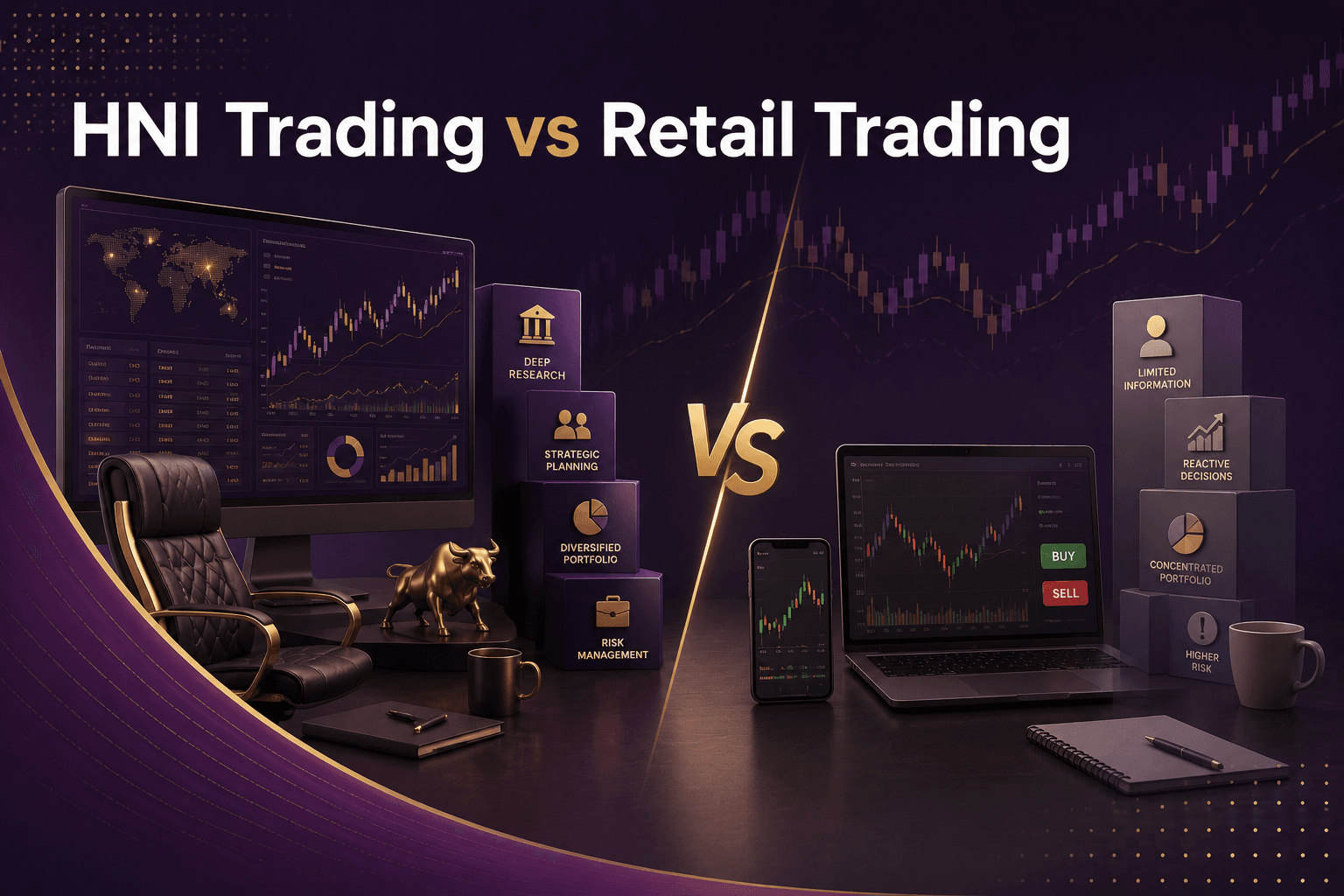
HNI Trading vs Retail Trading: Key Differences
While it may seem like the type of investor is the only difference, there's actually much more involved.
Let's understand this with a simple comparison:
| HNI Trading | Retail Trading | |
| Capital | Higher investable surplus (often ₹5 crore+) | Relatively smaller investment amounts |
| Access | Wider range of investment opportunities (e.g., AIFs, venture capital, PMS, where applicable) | Publicly available options (stocks, mutual funds, ETFs) |
| Advisory | May have access to professional advisors. | Mostly self-research or peer-influenced decisions. |
| Risk Approach | Structured and planned risk-taking | It can vary & may be influenced by market trends & volatility. |
| Tools & Technology | Access to advanced tools and insights (depending on provider) | Standard trading platforms and tools |
| Leverage | Access to higher leverage options like MTF (subject to regulations) | MTF facility is available here, too, but leverage could be limited. |
| Investment Approach | Often focused on diversification and long-term allocation. | Can include both short-term and long-term strategies. |
Limitations of HNI Trading
While HNI trading offers several advantages, it's not without its challenges. Having more capital doesn't always mean fewer risks.
Key limitations to consider:
- Higher absolute risk - Larger investments mean even small market volatility could lead to significant losses in value.
- Complex investment structure - Managing multiple assets like AIFs, IPO deals, and structured products can be complicated and time-consuming.
- Liquidity constraints - Some investments may have lock-in periods or limited exit options.
- Dependence on advisors - Decisions may rely heavily on wealth managers or external guidance.
- Access comes with conditions - Certain opportunities are subject to eligibility, minimum investment, and regulatory requirements.
Final Thoughts: Can Retail Investors Think Like HNIs?
A one-word answer would be "Yes."
You may not have the same capital, but you can definitely adopt the same mindset and discipline.
HNIs don't always rely on short-term gains. Instead, focus is on planning, diversification, and long-term thinking, with the help of a professional. And that's something any retail investor can start practicing, no matter the investment size.
Building a clear strategy, managing risks, and staying patient can make a meaningful difference over time.
Because in the long run, it's not just about money…it's about how you manage it.
Frequently Asked Questions
What is HNI trading in the stock market?
HNI trading includes investments made by individuals with high investable surplus, often with access to advanced strategies, personalized advisory, and a wider range of investment options.
How is HNI trading different from retail trading?
What is the minimum net worth to be considered an HNI in India?
Do retail investors have access to HNI-level products?
Is HNI trading less risky than retail trading?
Disclaimer
The information provided in this article is for educational and informational purposes only. Any financial figures, calculations, or projections shared are solely intended to illustrate concepts and should not be construed as investment advice. All scenarios mentioned are hypothetical and are used only for explanatory purposes. The content is based on information obtained from credible and publicly available sources. We do not guarantee the completeness, accuracy, or reliability of the data presented. Any references to the performance of indices, stocks, or financial products are purely illustrative and do not represent actual or future results. Actual investor experience may vary. Investors are advised to carefully read the scheme/product offering information document before making any decisions. Readers are advised to consult with a certified financial advisor before making any investment decisions. Neither the author nor the publishing entity shall be held responsible for any loss or liability arising from the use of this information.